

By Nargis Q.
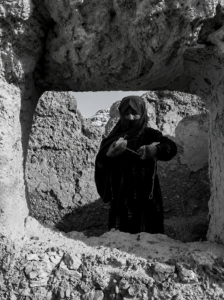
With dark, shadowed eyes and excitement, she sat down in front of her mother.
“Mom… when did you feel strong? I mean, when did you truly realize you were at your strongest?”
For a moment, there was no answer. An unusual silence filled the space. Not because she didn’t know what to say, but because the answer could not fit inside a single sentence. Some questions cannot be answered quickly. You have to go back through years, searching for where it all begins.
Maybe it was when, after marriage, she was alone with her little daughter and a thief broke into their house at night. With all her courage, she gathered herself and hid the child in a safe place. No one has the right to question a mother’s strength.
After she covered her daughter under a table with a cloth, she slipped out through the back window into the yard and screamed: “Thief!”
Maybe, if death had been waiting somewhere in that world, it would have happened that night. But it didn’t. She saved herself and her child with that single scream. And maybe that scream was her strength.
Or maybe not.
Maybe she was strong when she had to walk ten miles over rough stone just to weave carpets, only fifteen years old, yet already a mother.
Her hands were blistered. That day, even as illness made her dizzy and she wiped her running nose with shaking fingers, something inside her broke quietly. Yet she still bent down and lifted the weaving tool from the ground. Perhaps if she hadn’t stood up again, everything would have ended there. But she did. Maybe that moment itself was her strength.
Or maybe it was when her little daughter burned with fever and fear nearly tore her apart, her heart pounding out of her chest, because that tiny life was her entire world, and she didn’t know what to do.
Maybe mothers are afraid too.
And still, she ran.
Her breath breaking in the middle of the night, she finally reached the hospital, only realizing there that she had not even felt her bare feet against the ground.
Her entire life had begun with that girl.
Her husband had been wounded in the war. The same dark memory she herself had always feared. And yet it had happened: she now lived with a motionless man and a small daughter in a four-meter room, living a life that barely felt like life.
She never asked why.
She did not remember her own childhood, but she knew one thing: the world was not a place that would gently carry her toward her dreams.
Still, a voice inside her whispered:
You can.
Because she was like the wind, sometimes harsh, sometimes soft. Like sunlight that burns for her child, or water that moves forward with endless patience.
That was her strength.
Mother.
I looked at her. She was no longer a small child. There was something of me in her face, but not the kind that brings comfort. More like a reminder. As if life places a copy of you in front of you just so you can see what you have become.
I remembered.
I said aloud, “So… you want to know when I was strongest?”
She nodded. “Yes. Strong.”
I wasn’t even sure of the word myself. I had always thought I was simply continuing. And continuing is not always a choice.
She went silent. So did I.
My legs ached with a sharp pain. For a moment my thoughts drifted elsewhere, but I pulled myself back.
Then I said softly:
“If you really want to know… I have to start from the beginning. But if you truly want to hear it, you’ll have to lend me your heart.”
And so it began, my daughter…
“A girl?”
That was the first sentence I ever heard in the hospital.
A nurse’s voice slipped through the thin curtain, whispering. Calm—but carrying something quietly judgmental. She said an Afghan woman was in the ward. Then she added that if I had given birth to a boy, life would have been easier. Still, they could not believe I was the only woman there. Not just an Afghan woman, a woman.
You had not yet fully entered the world. My eyes were open, but my world was still incomplete, waiting for your arrival to become whole. Sounds came and went, unstable, as if reality itself had not decided whether to exist yet. But you already had two arms, two legs.
Then a voice behind the glass said:
“She gave birth to a girl.”
A girl.
That single word was enough. Someone sharply cut the nurse off.
“You weren’t enough, and now you’ve given birth to a girl again.”
I looked up.
And there I was.
I saw myself at that window, eyes swollen with tears, darkness circling beneath them, falling through layers of insult and memory. I asked myself:
Is it possible to be alive, yet bound?
To live, yet be afraid?
To be fearless, yet gentle?
Outside the hospital, a sudden burst of laughter echoed, short, meaningless. Leaves fell slowly from the trees, unnoticed. At that moment, something was recorded inside me. I did not yet know what it was.
Autumn.
I cried again and looked down.
A small being lay beside me, smiling. Her lips were so small I wondered how such a mouth could survive in this world. Her eyes, were they already shadowed like mine?
It was as if I was looking at my own reflection.
I understood then: she was the little girl I had been speaking to all my life. The child within me had stepped out and now lay before me. I had to accept her. Or maybe she had to accept me.
And I wasn’t sure which of us was real.
Years later I learned that some things are not understood at the moment they happen. They remain inside you until one day, their meaning returns.
I grew up in a house where being a woman meant not existing, or existing only by shrinking.
I learned to speak less. Not by choice, but by habit.
I learned that invisibility is not the same as absence.
I exist because I chose to.
Until my daughter was born.
She came from me, yet at that moment she was a stranger. Not because I didn’t love her, but because I did not yet know her.
And that is the simple, unbearable truth of motherhood.
I was not strong because I chose to be.
I was strong because there was no other way.
Because life does not wait for your permission.
I looked at her, the girl who came from me but was never meant to stay within me.
And I understood:
Every child is not only a new life,
but also a distance.
A distance between who you were…
and who you must become.
I took her hand.
My younger self had reminded me, without knowing, that I was still worthy.
She wasn’t listening, but she was there.
And I used that moment to release everything I had carried inside me for years.
Life, for a brief moment, became still.
And I thought to myself:
You are a stranger who has become familiar.
You came from me, but you are not meant to remain like me.
You are free to live not as the world is, but as you can be. As you must be. Not as a maybe, but as a certainty.
So one day you can say to yourself: Well done, girl.
You brought the world into existence for me.
And without you, the world would have been nothing.
Nothing at all.
And I must learn to live beside that truth.
And beside you.
I came back to myself.
She was still too small to understand what awaited her in the world.
So I gave her a tired, gentle smile and said:
“You… you are the best thing that ever happened to me. You are my strength.”
Maybe she had been waiting her whole life for that question.
Author bio: Nargis Q is an Afghan writer and storyteller whose work explores identity, memory, displacement, and the quiet resilience of the human spirit. Through fiction and poetic prose, she seeks to transform personal and collective experiences into stories that foster empathy, reflection, and connection.