

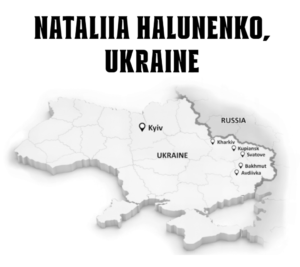
When Russia launched its full-scale invasion of Ukraine on February 24, 2022, thirty-year-old violinist Nataliia Halunenko was in her hometown of Svatove in the Luhansk region of eastern Ukraine. Within days, the Russian army had advanced rapidly westward across the region, occupying villages and towns with lightning speed. It even threatened to take the capital of Kyiv, in the middle of the country.
By March 8, Russian troops had already occupied Svatove, trapping Nataliia there with her parents. Russian soldiers soon captured her mother, who was a prominent journalist in the city, and held her for three days for interrogation.
“It was terrifying,” Nataliia said. “When they released her, I decided to leave. And when I saw some friends and neighbors in Svatove choosing to side with Russian soldiers, something broke inside me and made me more determined to get away.”
She explored ways to escape.
“There were drivers who took people out for money. You could go through the occupied territory, across the border into Russia, and then leave Russia and go into Europe, but it was dangerous, long, and expensive. I decided on another route—also dangerous, but faster,” she explained. “At that time, the demarcation line between the armies was at the town of Pechenihy, where there is a dam. Ukrainian and Russian troops faced each other across the dam. The driver took us through the only possible road, via Kupiansk, to Pechenihy. I was traveling with another woman and a guy. We had to pass through twelve Russian checkpoints. Some we went through without incident; at others we were held for a long time, and Russian soldiers abused us verbally.”
The road was so damaged, the car could only get to within a mile and a half of the dam, and then she had to walk.
“There were a lot of people trying to cross,” Nataliia recalled. “You could leave only at certain hours on certain days. Some people were carrying suitcases, bags, and pets. Some of the animals ran away into the bushes, and it was impossible to go after them because the surrounding land was mined. I had only my backpack and my violin. When we crossed the dam, we were put on a bus to Kharkiv and given a hot meal.”
Once there, Nataliia was free to settle anywhere in western Ukraine or to continue on to a place of greater safety in Europe, as millions of Ukrainian women and children did. (Men between the ages of eighteen and sixty were generally not allowed to leave the country.) Nataliia chose to stay, basing herself close to the front line in eastern Ukraine. She began volunteering with her sister in a food kitchen in Ukraine’s second-largest city, Kharkiv, which is about the size of Philadelphia and just twenty miles from the Russian border.
This abrupt change meant Nataliia had to put her promising musical career on hold.
She had previously spent three years working as a violinist in India and had planned to move back there to restart her life as a musician. Although classically trained, she played mostly popular music at weddings and lavish corporate events and thrived in the high-octane adventure of India’s music scene.
“Music was everything to me, my life, my passion. In India we played a lot of Bollywood tunes, and so it took a while to adjust to the new music, but I loved it,” Nataliia said, laughing, “though I don’t miss playing the Titanic theme tune over and over again.”
She had hoped to return to that life of crisscrossing India, playing gigs all over the country, but the Russian invasion changed everything. By the summer of 2022, she was in Kharkiv, packing humanitarian aid and food parcels to be taken around the city and
to communities right at the front line.
Kharkiv is a hard, gritty city with a reputation for endurance. During the Second World War, it was captured by Nazi Germany in late 1941, taken by the Soviet army in February 1943, and recaptured by the Germans a month later before finally being retaken by the Soviets five months after that.
In Russia’s lightning-fast invasion of Ukraine in February 2022, the city looked like it was on the brink of being surrounded and captured. Tens of thousands of locals fled by rail and road. By that summer, when Nataliia arrived, Russian soldiers were camped on the outskirts of the city, constantly bombarding it with artillery shells and other missiles.
Kharkiv’s infrastructure of shops and transport had largely shut down, the streets were nearly empty, and hundreds of people were living in the metro stations, having been bombed out of their homes and staying underground to survive the missiles.
Many locals remaining in the battered city relied on getting food, medicine, soap, and other necessities from volunteers like Nataliia. She was helping Kharkiv to survive, making a difference, but she felt it wasn’t enough.
“At first I was making food parcels for people living on the front line,” she said. “Then I agreed to help deliver them.”
Packing food parcels in a city constantly pounded by shells was risky; taking them to civilians living at the very front was choosing to do something much more dangerous. Nataliia agreed to join a Polish volunteer to deliver food in December 2022 to the city of Bakhmut.
“It was my first trip to such a frontline city,” she said. “I didn’t really understand how many streets were destroyed or how much shelling there would be until I got there. We took medical supplies and food for people there and offered to evacuate anyone who wanted to leave. People were just huddled together in cellars, a dozen in some places, a couple of dozen in others, hiding from the bombing and waiting for the food we brought them. We took an older guy out who wanted to leave—he couldn’t move much because he had a problem with his leg, so we took him with us.”
Two months later, she went to Avdiivka, whose name has been burnt into the history of the conflict as a place of extreme brutality and danger. Russia’s assault on the city lasted several years, and by the time it was finally captured in February 2024, the city had been reduced to rubble.
When Nataliia went there in February 2023, Avdiivka was still an urban battlefield, with many thousands of casualties in both armies in the grinding street-by-street conflict. Hundreds of civilians were also killed and injured, and many others were trapped by the bombings, too scared to make the journey out.
These experiences changed her. Nataliia decided more of this dangerous but vital work was what she needed to do. She began to take medical supplies and humanitarian aid along as she ventured into the most frightening areas of the eastern front.
“In Bakhmut, when you leave the van to deliver boxes of aid, you find yourself running, running all the time, because the explosions are all around you, sometimes only twenty yards away,” she said.
I first met Nataliia when we were in an ambulance delivering medical supplies to the frontline city of Kupiansk in November 2023. Sitting in front of me with her trademark orange hair glowing against her flak jacket, furiously puffing on a vape, she turned to shout to me over the blaring Ukrainian rap music. We were slaloming at high speed through the deserted streets under bombardment.
“The artillery attacks continue all day. It’s pretty random; anything here can be hit at any time,” she said.
The shelling was almost constant, with black and white plumes of smoke rising on either side of the roads as missiles exploded. It was a rough ride for a while, and we hung on to what we could inside the ambulance as the wheels skidded and slipped in the mud.
We brought medicine to people living in high-rise apartment buildings who were unable to walk or to get down the many steps to the outside. The city’s electricity had been cut in the bombardments many months before, and the buildings’ elevators no longer worked.
“Some people just can’t leave,” she told me as we walked up the stairs of a battered apartment block. “Many old or infirm people stay in their homes, often with a family member to look after them. Some are just more afraid of leaving than staying.”
As we talked, the ambulance’s radio crackled with a warning that the small bridge we were heading for was being shelled.
—
Excerpted from Defiant: Profiles of Resistance, available beginning October 13, 2026, wherever books are sold. Copyright © 2026 by Brian Dooley. Reprinted by permission of Humanitas Media.