

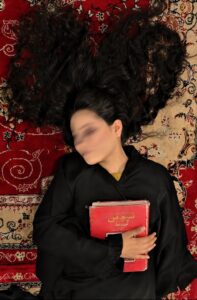
In early June 2026, the Taliban governor of Herat, a province in western Afghanistan, issued a decree declaring that the manto, a garment worn by generations of women in Herat that covers the body from head to toe, is no longer acceptable and that women must not show their eyes. Women were ordered to wear clothing deemed acceptable by the Taliban, although no clear standards were provided.
The manto has now been declared unacceptable by the Taliban’s Ministry of the Propagation of Virtue and Prevention of Vice. This crackdown marks a new phase in the Taliban’s enforcement of control over Afghanistan’s population, particularly women and girls, not only through laws and decrees, but also through public displays of coercion and fear in everyday life. From taxis and traffic intersections to neighborhoods and private homes, women are being intimidated into staying indoors. As one of our students said, she is unable to go outside due to family fears, unreasonable searches by the Taliban, disturbances, and most dangerously, seizures and kidnappings.
The Taliban’s Ministry for the Propagation of Virtue and Prevention of Vice in Herat has extended its reach even to the gates of private homes in areas such as Jebrail, where many girls and women have reportedly been detained, warning residents to comply with Taliban-imposed dress codes and ordering women to remain inside. Large numbers of Taliban forces have also been deployed at major intersections throughout Herat and other cities. In the past week alone, dozens of women have reportedly been detained and subjected to insults, humiliation, and verbal abuse.
As a result, daily life has become increasingly difficult. Many families no longer allow women and girls to leave their homes out of fear for their safety. At the same time, local Taliban officials appear eager to demonstrate loyalty to the supreme leader of the Taliban, Hibatullah Akhundzada, by aggressively enforcing these restrictions.
At EmpowerHer Initiative, we checked in with our students to learn how they were coping in these hard times. One student told us: “I am not okay at all. I am very scared. Yesterday, the Taliban took a girl from Dasht-e-Barchi, Kabul, and I saw it. It was really terrible. My family knows about it, and they didn’t let me go outside today.” Her words reflect a growing reality. As families become more protective, women are increasingly confined to their homes. For many, occasional trips outside, visits to markets, or seeing friends were among the few remaining sources of joy and freedom. Now, even these limited freedoms have been taken away from them.
Hasht-e Subh media reported that around 50 women were detained during June 6th and 7th, the first two days of the Taliban’s enforcement campaign in Herat. Many were forced, along with their family members, to sign pledges before being released. Reports indicate that those detained were subjected to insults, humiliation, and verbal abuse. In response, many Afghans, activists, and public figures voiced their concerns and encouraged peaceful protests. Posters calling for demonstrations circulated widely across social media, particularly in the Jebrail district of Herat.
This led to a protest on Tuesday, June 9th, when women and men gathered in Jebrail to oppose the new restrictions and demand the release of girls and women who were detained. Protesters chanted:
“Women, Life, Freedom.”
“Bread, Work, Freedom.”
For many Afghans, this was a significant moment. Men stood alongside their sisters, daughters, and wives, publicly demanding dignity and rights for women. However, Taliban fighters violently suppressed the demonstration. Eyewitnesses reported that Taliban forces opened fire directly into the crowd, killing two people, including a woman, and injuring nearly 30 others. Videos circulating online appear to show Taliban fighters shooting at protesters. Human rights organizations and anti-Taliban activists have widely condemned the incident.
Since the protest, Herat has remained under heavy security control. Restrictions on women’s movement continue, and reports of detentions persist. The violence did not end there. Out of fear of arrest and retaliation, many injured protesters avoided hospitals and were instead treated at home. Some reports indicate that Taliban fighters were stationed inside hospitals, identifying wounded protesters and detaining their family members.
Following the crackdown, hundreds of additional Taliban fighters were deployed to the Jebrail district. Videos shared online show military vehicles and armed personnel stationed throughout the city, transforming Herat into what many residents describe as a heavily militarized zone.
Solidarity protests have also taken place outside Afghanistan. This week, Afghan communities in Tehran gathered to support those protesting in Herat and to speak out against the ongoing restrictions on women.
The crackdown in Herat is not an isolated event. Women in other provinces report similar pressure and intimidation. Across social media, posters calling for protests in Kabul, Mazar-e-Sharif, and other cities continue to circulate. As restrictions increase, many Afghans believe public frustration is reaching a breaking point.
At EmpowerHer, our students and our staff members from within Afghanistan continue to express deep concern about their future and their ability to live freely. One student in Kabul told us: “There is supposed to be a protest in our area tomorrow. We would like to participate, but some people are saying it may have been organized by the Taliban and could be dangerous.” She also emphasized that her greatest concern now is being Hazara (an ethnic minority in Afghanistan). She shared that the situation has become increasingly difficult and frightening, and that many Hazaras feel especially vulnerable. As a Hazara woman, she fears that the challenges facing her community are becoming more severe with each passing day. Another student shared: “A few girls were arrested in Dasht-e-Barchi, Kabul. According to local reports, one of them took her own life the day after she was released. No one knows what she experienced during her imprisonment.” These are heartbreaking words to hear from young women whose only wish is to live, learn, and dream freely. Our students should be worrying about exams, university applications, friendships, and their futures, not whether they will be arrested for leaving their homes or whether they will survive the next day.
What is perhaps the most painful is the uncertainty. Many of our students no longer have hope for tomorrow, and they don’t know whether new restrictions will be announced, whether their families will allow them to leave the house, or whether they will be safe if they do. Fear has become a constant presence in their daily lives.
Yet, despite these realities, our students continue to attend our mentorship programs, write their stories, and support one another. No girl should have to wonder whether leaving her house tomorrow will put her life at risk.
Behind every statistic is a human being: a daughter, a sister, a student, a teacher, a story, a writer, and more. These voices remind us that the crisis in Afghanistan is not a political abstraction. It is a lived reality affecting millions of women and girls every single day.
We would like to end with the words of another student: “I am so uncertain about tomorrow. I cannot even guarantee that we will be alive tomorrow simply because we may not wear a burqa or because we leave our homes.”
These voices must be heard.
We must not allow fear, repression, and violence to silence Afghan women. The international community cannot continue to look away while half of Afghanistan’s population is stripped of its most basic human rights.
For the EmpowerHer Team and community, these events are not simply headlines. They are the daily realities of the girls and women we work with. Our students are not reading about these restrictions from afar; they are living through them. Every week, we hear stories of fear, uncertainty, and resilience from young women who continue to pursue education and personal growth despite enormous obstacles.
EmpowerHer’s core belief is that every Afghan woman deserves a voice and that every story deserves to be heard. When women are pushed out of public life, storytelling becomes an act of resistance. When their voices are silenced, writing becomes a way to preserve their experiences and humanity.
We remain committed to providing educational opportunities, mentorship, and publication platforms for Afghan women and girls. We remain committed to listening to them and supporting them to write Afghanistan’s history through their lived experiences. Their stories should not be reduced to statistics or forgotten in news cycles. We call on the international community, including the United Nations, human rights organizations, and NGOs, to stand with Afghan women and girls. This is not the time for silence or inaction. Afghan women need access to education, mental health support, and humanitarian assistance. Most importantly, they need sustained international advocacy that keeps their rights and freedoms at the center of global discussions on Afghanistan.
After all the arrests, restrictions, fear, and uncertainty, one of our students left us with these words: “We are still here, and we still have hope.”
Works cited:
- Kawa, Amin. “Taliban Open Fire on Herat Protesters, Shoot Women and Demonstrators in the Streets.” Hasht-e Subh, 10 June 2026, 8am.media/eng/herat-protest-taliban-shooting-women/. Accessed 11 June 2026.
- Kawa, Amin. “Loyalty to Akhundzada: Is the Oppression of Women Becoming a Power Game among the Taliban?” Hasht-e Subh, 9 June 2026, 8am.media/eng/taliban-women-oppression-power-herat/. Accessed 11 June 2026.
- Students, EmpowerHer Initiative. Voices from Afghanistan. 10 June 2026, www.empowerher-initiative.org. Accessed 10 June 2026.
Bio: EmpowerHer is an organization dedicated to empowering Afghan women through mentorship, education, and publication opportunities. By creating spaces for learning, storytelling, and leadership, EmpowerHer helps Afghan women develop their skills, share their experiences, and amplify their voices within their communities and beyond.
Photo: Owned by: EmpowerHer Community Member, Farangis Anwari