

By Saima Zafar
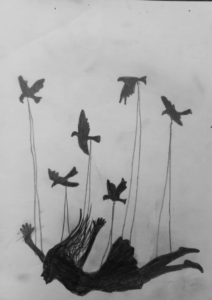
“Who said kafan is only white?” Mahnoor whispered. “The dress I am wearing are red, but they are kafan for me.”
Aima had no reply.
The place seemed to be like a dark room. The wedding music was still loud outside. Everyone seemed to be laughing and dancing, yet Mahnoor stood frozen.
“I can hear the music,” she said, “but all this sounds like my last breath. Do you see my soul leaving my body? Why does no one notice me? Am I not visible?”
She went to the wardrobe and took a small wood box, very well designed by her father.
“Aima, this is all I have. I put my dreams in this box. This box belongs to you now.”
Aima could not say anything.
“It is late,” Mahnoor whispered. “It is time to say goodbye, to my dreams and to my best friend.”
They cried together.
Aima left the house with millions of questions.
It was neither bright nor dark. She could hear dogs barking, but she hardly noticed them.
She recalled her school days.
She recalled her school days.
She recalled Mahnoor writing poetry on the blackboard in her class.
One sentence stayed in her mind:
I am afraid that I will lose myself at the end of my journey.”
“I am scared of losing myself by the end of my way.”
They had once made plans to write novels together.
When she reached home, her mother opened the green door adorned with yellow roses.
“Oh, Aima! How was your friend’s wedding?”
Aima smiled weakly.
“It was fine, mother.”
She remained motionless sitting in the corner of the room.
Later, her mother brought food and sat next to her.
“What is going on?”
Aima finally looked at her mom.
“My dear mother, is dream-fulfilment a sin?”
Her mother was silent.
“Why was Mahnoor punished for publishing her story? Why cannot they remember that the money she received thanks to her writing was spent on her father’s treatment? If she had been a boy, everyone would have celebrated him.”
Tears clouded her eyes.
“Is it really a sin to dream?”
Her mother exhaled deeply.
“Dreaming is not a sin but society thinks otherwise.”
“Maybe Mahnoor’s dad thought he was doing the right thing for the family. But people sometimes forget to protect the ones they love while solving matters of their honor,” said the man. Both girls started crying.
That night, Aima could not sleep.
She felt stabs in her bed. She walked for a while in her room and noticed a box of wood.
So she tried to gather her courage and open it.
Inside was a dried flower.
Aima recognized the smell.
Aima gave it to her after she won the contest for writing.
There was a bottle of perfume, a necklace that belonged to Mahnoor’s aunt, and an envelope.
On it were the words:
The Words That Became Wings.
Aima sat on the bed.
Dawn began.
She opened the letter.
“Dear Aima,
I am afraid I will not become the person I had dreamed of becoming.
I am afraid that my dreams will remain dreams.
my body will return to the earth, the place where I belong.
If you read this letter, I want you to know that this hurt you. But please don’t carry only my pain.
I leave the ash of my dreams to you. Paint the world with it.
A blue notebook was to mark my story, but it remained unfinished.
I wanted to change the ending of my story, but time was not enough.
You can complete my story with your dreams.
And when you become a writer one day remember me.
Your friend,
Mahnoor. “
Aima’s hands were shaking.
Suddenly there was a scream from outside.
She rushed to the window.
A crowd was collecting in front of Mahnoor’s house.
The thought which she wanted to avoid was born in her mind.
“What if Mahnoor died?”
The envelope slipped from her hands.
She ran barefoot down the street.
Reaching the house she opened the door.
Mahnoor lay dead on the floor, wearing her red dress.
Her mother was beside her crying.
“Oh my daughter what can I do for you, I could not save you.”
Her father was just standing in the corner silent with tears on his face.
There was ash all around. The ash of her books,diaries, dreams,.
Everything had burned down.
But there was one thing left on the table.
The blue notebook.
Time passed.
Aima visited Mahnoor’s grave every Friday.
For months, she was unable to open the notebook.
But one day she did.
She read every single story.
Every poem.
Every unfinished sentence.
Only the ending was missing.
Aima carried the notebook to Mahnoor’s grave.
She sat beside her and said, “I know you are not here, but I told you that I would do something for you.”
Aima opened the notebook
“I will write the ending you could not.”
And she started to write.
She wrote about a girl who lived.
A girl who struggled for her dreams.
A girl who bravely opposed the cage of tradition and wouldn’t let society define her future.
She didn’t write this ending because Mahnoor’s ending was bad.
She wrote it because someone may need the story in the future.
A few months later, Aima published the story.
People read the story.
The story became a success.
But it was never only Aima’s story. Mahnoor had written the beginning. Aima had written the ending. Two friends. Two different lives. Two different beginnings. One unfinished dream.
And even after the success, one question remained in Aima’s heart:
Why do some people become the brightest stars in the sky, while others spend their lives only wishing for the sky?
She never found the answer.
So she kept writing.
Image Credit: Author
Author Bio: Saima Zafar is a writer and artist from Afghanistan whose work is shaped by her experiences of displacement, loss, and resilience. After being accepted into Kabul University’s English Literature program, her education was interrupted when universities were closed. She turned to writing and drawing as ways to express emotions she could not put into words. Through online courses, particularly philosophy, she discovered new ways of understanding her experiences and developed a deeper appreciation for creativity, reflection, and questioning. Today, Saima continues to believe in the power of writing to transform pain, preserve memory, and create new possibilities for the future.