

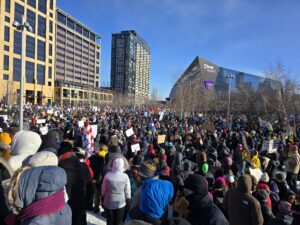
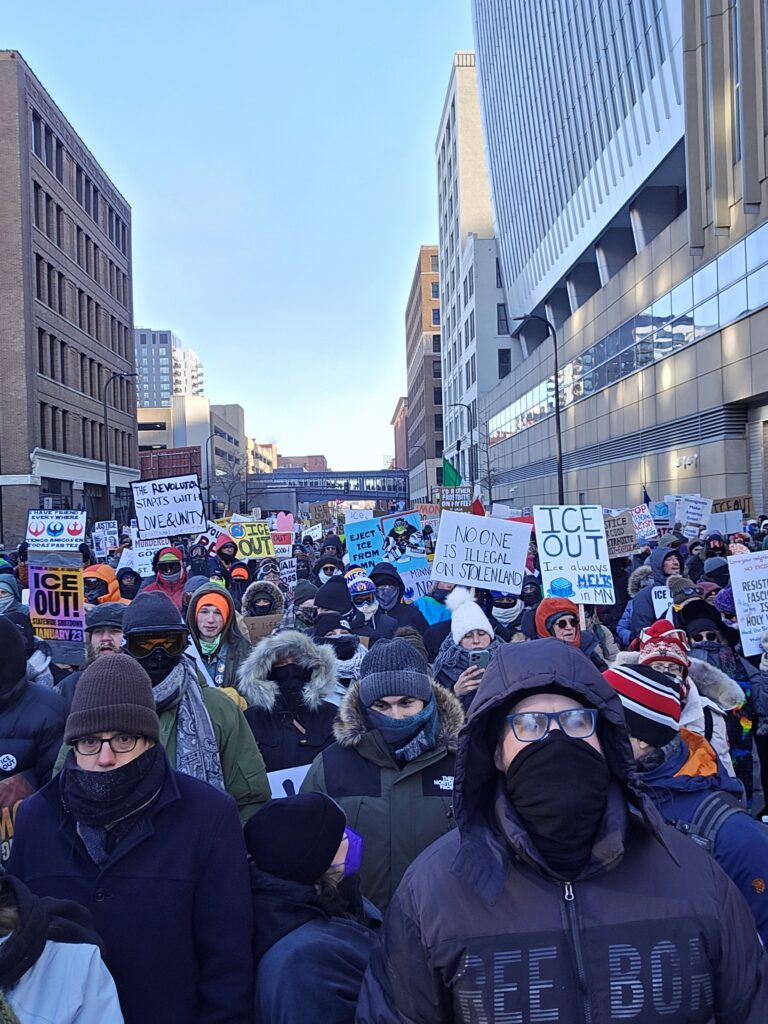
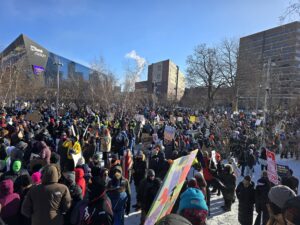
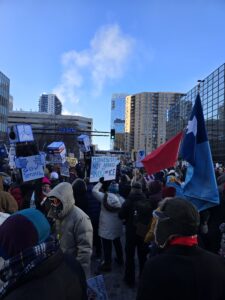
 On Friday, January 23, I joined tens of thousands of Minnesotans in a march through the streets of downtown Minneapolis in solidarity with the ICE Out of Minnesota movement. Despite the dangerously low temperatures (-10 degrees F), the protest left me with a strong sense of community, empowerment, resilience and above all, hope. The next day, we received the soul-crushing news that federal agents had murdered another member of our community, Alex Pretti. In less than 24 hours, we were right back down in the feelings of anger, fear, loss and the overwhelming sense that things were only going to get worse.
This constant swing between feelings of grief, fear and despair alternating with hope, community and love have come to define life in Minnesota over the past several months. I have called Minnesota home for nearly two decades now, and while we’ve been here before—most notably after the murder of George Floyd in 2020—I have never been as heartbroken for my community.
Life in the Twin Cities is heavy right now. Not just in the headlines, but in our bodies. You can feel it in the way conversations start mid-sigh, in how quickly energy moves from alert to exhausted, from activated to withdrawn. This weight isn’t abstract—it’s familiar, frightening and cumulative. For many of us, it feels like we are being asked—again—to carry grief, anger, fear, and responsibility all at the same time. If you have any sense of empathy and love for our fellow humanity, then you are probably dealing with the effects of stress fatigue.
The sheer scale of the indignity, racism and hate that has been mobilized against our community has brought these stressors close to home for everyone. Friends, family members and coworkers share stories about ICE agents appearing at their homes, at work and in their neighborhoods. Regardless of citizenship status, people of color are being profiled, stopped, questioned, harassed, detained, and often even worse. Even those of us with the kind of privilege that allows us not to fear these kinds of encounters in our everyday lives face intimidation and the threat of violence for peacefully observing and supporting our neighbors. One of my coworkers, a middle-aged white women, was followed by ICE agents to her neighborhood in the Minneapolis suburbs, where she was verbally assaulted, ostensibly for being a peaceful observer at a nearby ICE raid. Our neighbors and friends are being harassed, tear-gassed, beaten and detained for peacefully observing ICE actions. Alex Pretti and Renee Good were both executed in the streets of Minneapolis for trying to help their neighbors.
Almost all of us know people who have had these experiences, and the resulting fear has the potential to really shrink our lives. Our friends and loved ones are afraid to step outside, afraid that the next knock on the door might be for them. They plan errands carefully or do not leave their homes at all. They don’t go to work. The fear reshapes daily life in ways that are quiet but profound.
This is especially heartbreaking when it affects our children. My niece’s best friend—a daughter of Latine immigrants just eleven years old— stopped coming to school. Her family disappeared overnight. No notice. No explanation offered to the community left behind. Just absence. The kind that leaves children confused and adults scrambling for words that don’t exist. We struggled to find them when explaining to my son—also eleven years old—why his cousin, her parents and all the adults in his life were struggling. He asked me, simply, “Am I safe?” It broke my heart. Watching our children’s innocence unravel is unsettling. No parent wants to calculate how much truth a child can handle while still letting them sleep at night. And this is even more devasting for our children who have been left behind or separated from their families as a result of these heartless and illegal immigration practices.
These everyday encounters remind us that fear and stress don’t arrive all at once. They accumulate quietly, through stories that don’t always make the news but change how people move through their days. Many Minnesotans—myself included—are helpers by nature and by our roles in the community. We are accustomed to holding others steady, showing up with clarity and compassion. Doing that while our own nervous systems are activated—while fear and grief are close to the surface—takes a toll. Feeling anxious, fatigued, or overwhelmed isn’t weakness. It’s a normal response to repeated trauma. We are not just exhausted; we are worn down by the sense that these moments keep coming, one fear following another.
This is one story of Minnesota, but it is not the one we will tell.
Despite the heaviness, despite the grief, despite the fear, we have seen people step toward one another with purpose and care. At the protest itself, beyond the marching and chanting, what struck me most was the quiet support: people taking care of each other, sharing water and hand warmers, putting their bodies through the pain of subzero temperatures to speak in solidarity for those whose voices have been silenced. This was compassion in action and the real-time creation of community.
In the weeks since Operation Metro Surge began, community groups and nonprofit organizations I know well have mobilized around mutual aid and rapid response efforts—delivering groceries and supplies to those afraid to leave their homes, offering know-your-rights trainings, accompanying neighbors to appointments, observing dangerous enforcement activity, creating networks that help people feel less alone, and providing legal and family supports to those that are detained or left behind. These individual actions are the slow, steady work of care that happens when a community decides it will not be fractured by fear alone.
Individuals build community through love and compassion. Communities build movements. And movements change politics in enduring ways.
In response to the deaths of community members like Alex Pretti and Renee Good, thousands turned out in Minneapolis and cities across the United States for solidarity protests—part of a growing nationwide movement pushing back against aggressive federal enforcement. Just as much as the headlines, the stories and footage shared by Minnesotans documenting and standing up for their neighbors are shifting the national discourse about immigration policy in the United States. Against an opposition that enthusiastically deploys and weaponizes mistrust and disinformation, I have been heartened by the response from Minnesotans who are turning their anger and grief toward the peaceful and lawful observance, documentation and civil disobedience. Minnesota is also building the playbook for how to respond to this kind of authoritarian crackdown in our cities, laying the groundwork for how to organize and mobilize against these efforts as they move to other cities and communities across the country.
Through all of our efforts, there is a shared conviction: that dignity matters; that solidarity matters; and that resistance to injustice is not only political, but human. It is the right thing to do.
As a father, this part matters most. One sign that stuck with me from the protest: “Love your children so they don’t grow up to be ICE agents”. It’s a bit tongue-in-cheek, but a good reminder that even our everyday kindness has profound implications. I want my children to see that care is an action. That showing up doesn’t always look loud or heroic. Sometimes it looks like choosing community over isolation. It looks like staying in the work, even when it’s hard.
Minnesota is hurting, but it is also practicing care—quietly, collectively and with resolve. This is not a sprint. Despite the recent change in Trump administration rhetoric, we know we are in this for the long haul. We will need each other—for rest, for support, for clarity. The bad news deserves to be named honestly. But even more so does the hope—that even in moments that ask far too much, people continue to show up for one another with grace and humanity.
Right now, that feels like the most important work there is. If you are not already involved, it is with deepest love and humility that I encourage you to do something, however small, to join the efforts in solidarity against the injustice affecting our communities in Minnesota. Together, we can build the kind of future we want, for us and for the generations of our children to come.
—
Matthew Murphy is the Partnerships Program Manager at The Saint Paul & Minnesota Foundation, where he provides relationship and project management for strategic initiatives and special projects in partnership with nonprofits, government agencies, businesses, and community members across Minnesota. With more than 15 years of nonprofit experience, he brings a deep passion for community-led initiatives, advancing equity, innovative problem solving, and supporting work that creates lasting public good.